If you still believe that everything will go back to normal in a couple of weeks, you must be living under a rock. Expect things to get worse, the Strait of Hormuz closed for months, petrol prices to skyrocket, and supermarket shelves to be sparse.
Food scarcity is nothing any living Australian would know, not even in tales of grandparents or old aunts. When diesel and urea run low, there is nothing even the most capable and well-meaning government could do, let alone our bureaucrats and officials.
Taking the food security of yourself and your family into your own hands is an act of sovereignty, resilience, and plain smart.
I put a bunch of ideas together on what you could do to take action. Some are more involved than others. I hope some of it inspires you!
#1 Don't grow Salads!
Not literally, yes, grow some salads, but in a food crisis, salads are not the crop that fills your tummy. Emphasise on pumpkins, carrots, turnips, and potatoes or sweet potatoes, beans, and corn. If you like perennial crops, Queensland arrowroot or taro are a good choice.
#2 Favour Animals over plants
I myself 100% prefer to grow plants rather than to raise animals, but the truth is that in the case of a food crisis, animals are the winners. My grandmother always talked about how people in the city would raise rabbits on their balconies during the Second World War. It was the rabbit and not the salad that kept them alive.
Many years ago, we had a friend from Cuba. He had this idea of raising a pig in a student accommodation. This was crazy for us, but not for him, because they did it in an apartment block in Cuba. This is how you survive hardship.
#3 Don't start a community garden
This one will certainly give me bad raps. Don’t start a community garden, the holy grail of Australian permaculture! If you have ever tried to start a community garden, you will know how much effort it is, how many bureaucratic hurdles you have to jump through, and how much time it takes to get all the red tape removed; you might just as well die of starvation until then. If there is already an existing community garden, have a look at how well it’s run, and you might want to join. But don’t have all too high hopes, most community gardens are not very productive, and the loner in me prefers the English allotment garden or the German Schrebergarten, each to its own, no communism and joint decisions. But that’s just my view; I believe communism doesn’t work, and joint decision-making is a waste of time. If you still want to start a community garden, this is still great, but I would see it more as a means to build community and meet people rather than a food-growing venture.
# Grow a choko vine or two
This is virtually a no-brainer, easy to grow, and you’ll harvest literally wheelbarrow loads of a versatile vegetable. Extra tip: chokos are ripening right now, get some, let them shoot on a windowsill, and plant! The only drawback is that deer and kangaroos love them too.
Grow one choko in your garden and give the other chokos away for others to grow them too.
#3 Do guerilla gardening
This is a bit cheeky and maybe not even legal, I don’t know, and I probably won’t be popular in certain circles with this suggestion, but you can’t always be a good girl. Guerilla gardening was a movement that started in the 70s, and the idea was to plant empty urban spaces with flowers, fruit trees, or other plants. The emphasis was to make the area more beautiful, but also to take ownership of the surrounding area.
This time it could be a bit more serious. You might want to emphasise growing food, rather than flowers. But then, a sunflower is both, and marigolds (calendula) are medicinal. Fill your pockets with seeds and pips, or stick some cuttings here and there.
Just be aware and don’t plant fruit trees that harbour and breed QLD fruit fly (in the rare case you don’t know the type of fly that stings the fruit and turns everything into a maggot-infested mush). In doubt, don’t plant or ask other gardeners in your area, because the fruit fly seems to attack different fruit in different areas.
If someone other than you harvests, they probably need it. The goal is to increase the overall amount of food grown in the area.
#4 Think chookfood
Most backyard chickens, including ours, are grain-converting operations: buy chickens, feed grain, harvest eggs. About 60% of Australia’s urea imports pass through the Strait of Hormuz, and a disruption in diesel supplies could make grains very expensive or simply unavailable.
Explore alternative ways to feed your flock, like cooked fish heads and guts, cooked and mashed Queensland arrowroot, azolla, black soldier fly, or a maggot bucket. You will still need grain for layer hens, but the amount could be reduced greatly.
#5 Learn to Forage
Learn to forage without poisoning yourself. There are not only poisonous plants or deadly mushrooms that kill you in a meal, but there are also councils that spray poisons on every verge, every stormwater inlet, and, of course, weeds to save the environment.
You might want to ask your local council where they spray, before starting your foraging adventure. With a bit of optimism, you might hope that this will start changing the way they think about these poisons.
While your foraged bounty might not deliver a lot in terms of starches, fat, and protein, wild plants are usually rich in vitamins and micronutrients. You will learn to distinguish a lot of plants, indigenous and exotic and that in itself seems to be a lot of fun.
#6 Water
I think we are at the beginning of a drier period. The last couple of years have been extremely wet, and that wouldn’t be Australia if a drought did not follow.
Councils usually restrict outdoor water use when supplies get low, and you are often not allowed to use mains water for your vegetable garden.
Setting up an independent water supply is prudent, but in most cases, it’s a high cost. Be aware that in most cases, it’s difficult to roll tanks in or get a bore done once all the fruit trees are planted, or the vegetable garden is in.
If you think about using greywater, as a general rule, never store it and let it out immediately with a flexible hose that is moved over the area.
Practise water-saving gardening methods such as mulching or chop and drop. Another great method if growing loads of bananas is to chop up the spent banana stems in manageable pieces, say 50 cm long and chop them in half lengthwise. Then lay the pieces cut side down around young trees or other plantsto keep them mois.
#7 Grow starch
Growing grain on a backyard scale is easy; processing the grain is not. Corn is a bit of an exception, but my trials growing amaranth resulted in a great harvest and delayed processing. In the end, we ate some of it, but most ended up in the chook run, and these silly chickens didn’t know how healthy this grain was and refused to eat it.
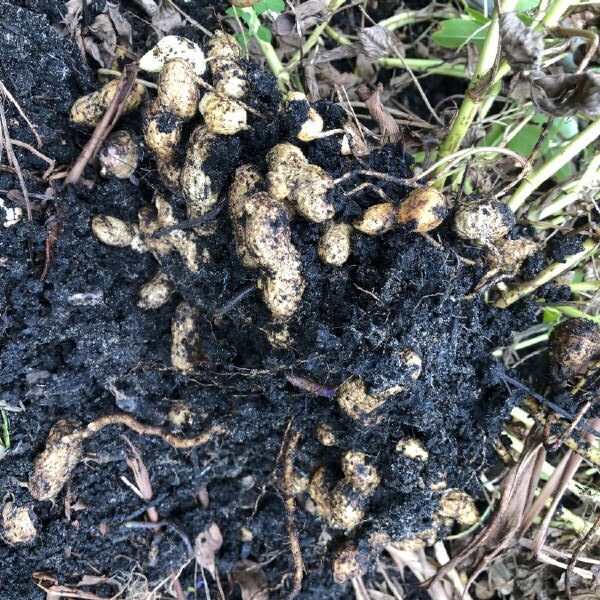
It is much easier to grow starchy tubers, no threshing, no winnowing. Apart from potatoes, there is Queensland arrowroot, true arrowroot, taro, the lesser-known mauka, and sugar cane, not a starch but still high in energy.
Jerusalem artichokes and yacon are very high-yielding plants, too, but they give you carbohydrates that humans cannot digest into simple sugars. That also means they give your body less energy. Still, both are very worthwhile to grow.
#8 The House Cow
This is a big project, and honestly, I have never cared for a cow. It is a big animal that needs huge amounts of food, milking every day at the same time, and just a lot of effort. Especially if you don’t have the size of land that actually sustains a cow, and have to scrounge all sorts of feed from outside. The worst thing? After milking, you still have to make cheese, butter, or yogurt, a completely new set of skills that seem challenging and time-consuming. On top of that, there is the problem that the cow needs a calf each year to give milk.
After all this negative talk, a well-cared-for cow would probably be the best asset in an SHTF scenario. The butter, the milk, the cheese, the cream, the calf are real bonuses, let alone the wonderful manure such a cow produces!
#9 Rethink your driveway
Parking your car on the road and planting the driveway is for extreme gardeners only, and very few would be prepared to even rip that driveway up. But maybe there is space for a couple of raised beds or huge pots?
#10 How many sheds do Men need?
How pretty would it look to get rid of all these unnecessary sheds filled with old junk no one uses? How much growing space could you generate by getting rid of all these boxes? Less utilitarian, you could create nice sitting areas where you meet with friends and indulge in homegrown goodies. In most cases, the answer to the above question is: ONE.
#11 Learn to grow without Bunnings
Growing vegetables has been turned into an assembly-kit hobby: 1. Buy a raised garden beds and install 2. Buy garden mix and fill the beds 3. Buy seedlings 4. Plant the seedlings and water.
While I do sometimes buy a trailerload of a mix or a trailerload of chicken manure, these are shortcuts to make life easier and achieve the results faster, but I still know how to fertilise a garden without the landscape yard, although with much slower results. Learn to make fertilizer brews, use seaweed, and other local resources.
It is not difficult to raise seedlings, and many, if not most, vegetables, are easily sown directly.
Raised beds are great if your land has poor drainage, floods, or if you are on a rock outcropping. Otherwise, just a reminder: our grandparents gardened in the soil.
#12 Grow Bananas
Bananas are more than only fruit: green bananas are a potato substitute. Plantains are better suited for that use, but there are also dual-purpose varieties. The banana flower is edible, and the interior of the stem can also be used in curries or as a juice.
Bananas are great to create a quick canopy in the food forest, and produce a bounty of juicy mulch that will grow your garden!
#13 How much space does your clothes line take?
Hills hoist used to be an Australian icon, born in a time when gardening consisted of lawns and flowers. It used to be placed right in the best growing area. Maybe let go of nostalgia and get something foldable. And this permaculture idea from back in the days of the “Grassroots” magazine sounds nice, but does not increase real growing space (only older folks will get this!)
#14 Beds, Paths and spacing
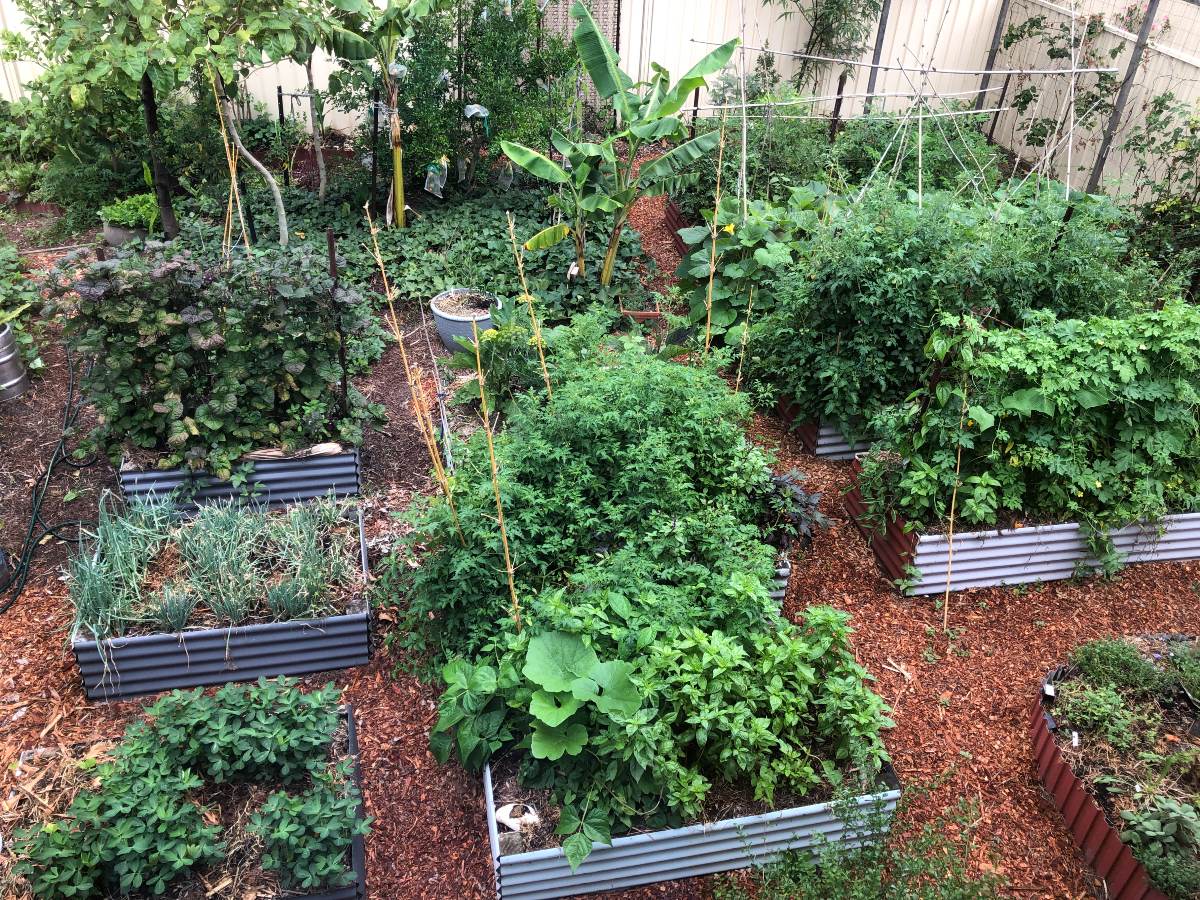
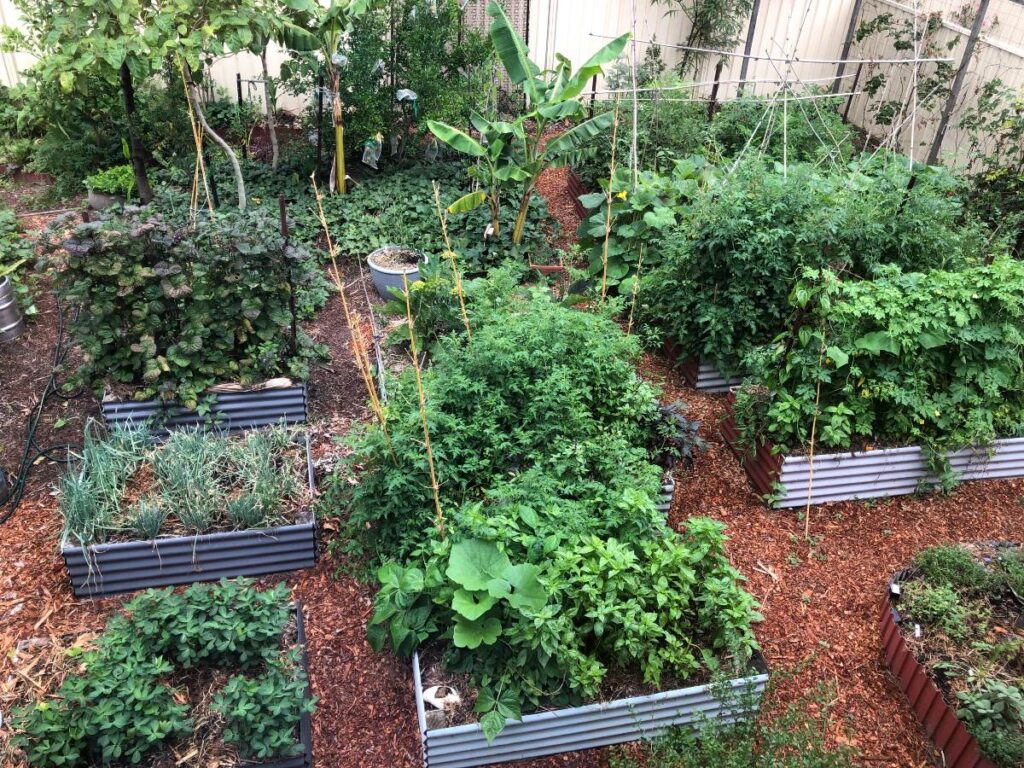
Most vegetable gardens are lawns with some raised beds dotted in them. Think the other way round: the gardens consist of beds with walkways in between. How wide does a walkway have to be? That depends, for in-ground beds that could be small paths say 40 cm wide, for raised beds that would have to be more. I spaced ours roughly 55 cm, but if you build higher raised beds or want to get through with a wheelbarrow it would have to be wider.
#15 Grow mushrooms
Apart from some failed attempts, I have zero experience growing mushrooms. But yes, if space is tight, mushrooms are ideal. I think it’s a great idea, but for me it’s like the cow – I would prefer if someone else did it.
#16 If you don't like growing and don't like caring for animals
I know people who are just not gardeners and have no shred of a farmer in them. (But then would you read this blog?) Anyway, we all need those more technically minded folks that can sharpen tools to perfection, build wind turbines or a biogas digester out of a pile of junk, can repair all sorts of things, you name it. You have my highest admiration!
#17 Grow shade lovers
Fill any shady corners with shade-loving edibles, lettuces, Okinawan spinach, Longevity spinach, vegetable fern, Lebanese cress, or mushroom cultures. Even coffee needs partial shade, so do most plants of the ginger family, vegetable pepper, and many medicinal plants. Most greens do well in shade or part-shade; there’s no need for using precious sunny space for all these lettuces!
I hope you got some inspiration, you may come up with a thousand more ideas and go through with at least some of them, and we get out at the other side!
If you want use the comment section fo sharing more ideas.