Soil Testing for Home Gardens: Why pH Is Not Enough
When it comes to soil testing, most home gardeners start by measuring the pH and then adding lime if the result suggests their soil is too acidic. But pH only tells you whether your soil is acidic or alkaline. It doesn’t tell you whether you have enough phosphorus, potassium or other essential nutrients. And here’s something that might surprise you: even alkaline soil can be short of calcium.
Soil pH does matter, though, because it influences how readily plants can access the nutrients in the soil. But it can’t tell you whether those nutrients are actually there in sufficient quantities in the first place.
For a quick pH check, I prefer the Manutech kit over similarly priced meters, as it has the reputation of being more accurate.
If you want to grow food successfully, even in a small home garden, a comprehensive soil test can tell you things a simple pH test never will. It can reveal which nutrients are lacking, which may be present in excess, and where your soil might need a little help.
We finally took the plunge and got a proper soil test done. And honestly, I think it was the best $250 we’ve ever spent on our garden!
Know your soil in suburbia
For suburban gardeners, the soil can be a real hotchpotch of original soil, imported fill, bought garden mix, compost and who knows what else. In such cases, a comprehensive nutrient test of the whole garden might not tell you as much as you would hope. You may need to test different areas separately, depending on what you want to grow and what you want to find out.
What if you’re growing all your vegetables in raised beds and your fruit trees in pots? This can be a sensible approach if your existing soil is contaminated or unsuitable for growing food. But it also means that your trees will never develop to their full potential; more water and regular repotting.
If you’re buying soil for raised vegetable beds, it’s worth asking your supplier what you’re actually getting. In Australia, AS 4419:2018 sets requirements for general-purpose soils, topsoil and landscaping mixes. Potting mixes are covered by a separate standard, AS 3743. These standards provide useful quality guidelines, but they don’t mean that every batch will be identical. Ask for the relevant test results for the product you’re buying, if available.
Depending on the product and the tests performed, the results may give you information about properties such as:
- pH and electrical conductivity (salinity)
- Organic matter
- Nutrient levels, including phosphorus and nitrogen in specified forms
- Other chemical and physical properties relevant to plant growth.
If you buy any soil for your vegetables other than a special veggie garden mix, ask wether the mix has ashes added. These ashes are sometimes added to soil mixes and are the waste product of coal-fired power stations.
Our Test Result - poor!
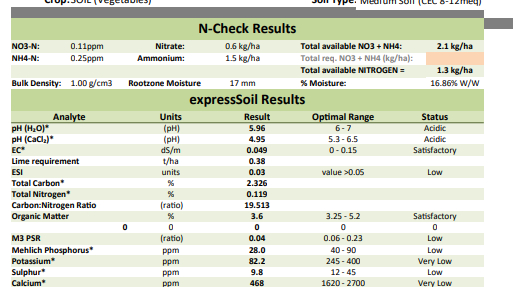
I’ve included our full soil test results below because I hope they’ll be useful to other gardeners in Bundabah, particularly those whose gardens fall within the area classified as Dermosol on the NSW eSPADE soil map.
eSPADE is a great, free resource. You can explore soil types, soil profiles and other information. However, the maps are a guide to the broader landscape, not a test of your individual garden. If you are in Bundabah and your property falls within the same classification, your soil is likely to be similar.
The guys at ACE Ohlsen were great, but the test results not so much. On the brighter side, while every nutrient is lacking, there are no excesses, meaning we don’t have to deal with any nutrient in toxic amounts; neither is our soil salty.
One thing worth mentioning: we did the test strictly on soil we did not improve or work on yet, so the result shows what the parent material is like
There is a takeaway message: we should have done the test five years ago, when we bought the land. The one nutrient we lack the most is calcium, which is also the cheapest of any fertilisers.
We plan to fill the exchange sites first with aglime, but also with gypsum. Gypsum has the capability of carrying the calcium into deeper layers. This is important for us, as we are growing a food forest and we should have deep-ripped the whole site before even starting. Now, we broadfork any new areas. We will add dolomite for the magnesium at a later stage.
We believed that because of the clay content of our soil, the CEC would be high, but it turned out to be super low. CEC describes the soil’s capacity to hold positively charged nutrients, including calcium, magnesium and potassium, and make them available to plants. A low CEC means our soil has limited capacity to retain these nutrients. We’re interested in using more biochar as part of our longer-term soil improvement efforts, alongside building organic matter and improving soil structure.
Compost is not enough
There is a school of thought that, with enough compost and organic matter, almost any soil can be turned into healthy, productive soil. Others focus on the microorganisms that help plants access nutrients, following approaches associated with the soil food web, Elaine Ingham, Korean Natural Farming and JADAM.
I love all these approaches, but can biology alone overcome severe nutrient deficiencies? Microorganisms need to eat, too, and they can’t create mineral nutrients that aren’t there.
Your homemade compost is made with the very materials grown on your deficient soil and, while very valuable, it cannot necessarily make up for severe mineral deficiencies. Used in large amounts, it could even lead to an excess of certain nutrients.
For us, soil chemistry is not a sin; we’re still organic, we still do permaculture, we love our invisible critters, we just do not follow that one approach.
How about Building a Community Soil Database, One Garden at a Time?
Wouldn’t it be great to have a website where gardeners from anywhere in the world could upload their soil test results, with the different laboratory methods and reporting formats converted into a common format so the results could be compared?
Perhaps it’s a project I’ll tackle when I’m retired! But if someone else takes it on in the meantime, I’ll be cheering them on.
For now, if you’re gardening around Bundabah or nearby and have had your soil tested, I’d love to hear from you. Get in touch, and let’s see whether we can learn something from comparing our results. Maybe we start with something as simple as a comparison table?